
THE ICONOGRAPHER WHO PRACTICES ICONOCLASM
There is something immediately contradictory about the work of Mark Doox. His paintings look as though they are asking to be venerated and vandalized at the same time.
Gold halos, frontal figures, flattened space, hieratic poses, and the visual authority of Byzantine religious painting coexist with racist caricature, Black popular culture, American political mythology, comic-book imagery, obscenity, and satire. Jesus appears beside Sambo. Sacred figures acquire the visual vocabulary of minstrelsy. American racial mythology enters the picture plane carrying both the authority of religion and the absurdity of Dada.
Doox calls the resulting language BYZ DADA—Byzantine Dadaism. The name initially sounds like another artist's convenient description of a hybrid style. Spend enough time with the work, however, and it begins to look more like a description of its underlying machinery.
Doox is an iconographer who practices iconoclasm.
That contradiction is fundamental to the work.
His relationship to Byzantine imagery is not merely stylistic. Doox encountered iconography through religious life and practice, and consequently approaches the icon as a functioning system of signs. Gold means something. The halo means something. Frontal presentation means something. Hierarchy means something. An icon does not simply depict a sacred subject; it places that subject within an established structure of meaning.
Doox retains that structure while introducing other American signs whose meanings are equally difficult to escape.
Among the most volatile of these is racist caricature.
The Sambo figure enters Doox's work already burdened by American history. Rather than eliminating that burden, Doox exploits it. The viewer is required to encounter the stereotype and whatever assumptions accompany it. But the figure does not remain where American visual culture placed him. Sambo becomes saint, prophet, fool, devil, theologian, and eventually something approaching an archetype.
The operation belongs to the tradition Henry Louis Gates Jr. famously theorized as Black Signifyin(g): repetition with a difference, inversion, parody, indirection, and the appropriation of inherited language for purposes its previous owners did not intend.
Doox extends that operation beyond language and onto the picture plane.
An image signifies upon another image.
A Byzantine icon signifies upon a racist caricature. The caricature signifies back upon the icon. Christian imagery signifies upon American racial mythology. Black history signifies upon Christianity. Dada signifies upon devotional art. Comic books signify upon religious painting. None of the original meanings completely disappears.
That last point is crucial.
Doox's pictures work precisely because their source languages remain audible beneath their transformations. If the racist image ceased to be recognizable as racist imagery, much of the tension would disappear. If the Byzantine structure ceased to carry sacred authority, its collision with profanity would lose its force. The paintings require incompatible meanings to occupy the same space.
This helps explain why Doox's work can be so difficult to classify. It can appear devotional and blasphemous, reverent and ridiculous, Black and post-Black, Christian and heretical, comic and deadly serious—sometimes within the same image.
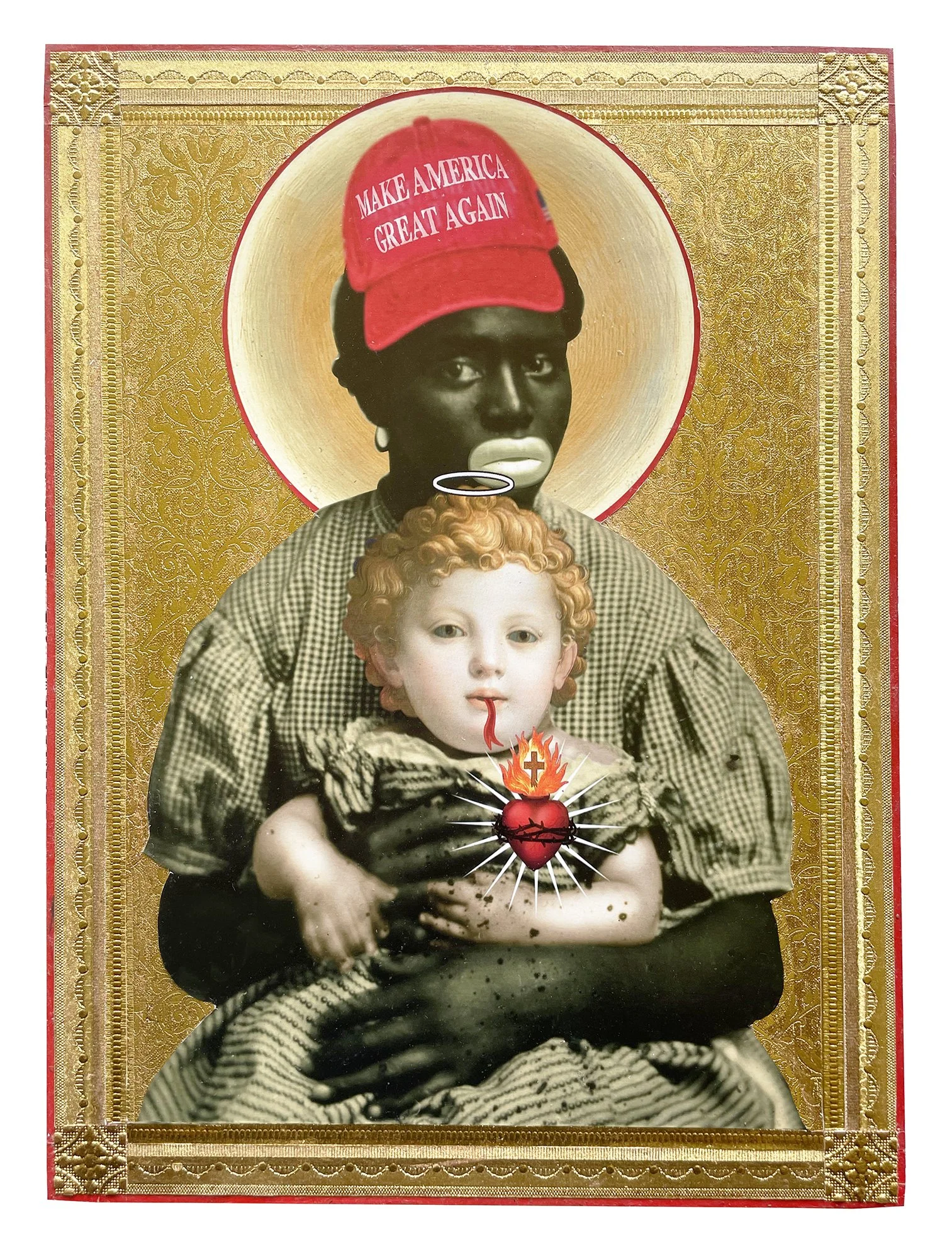
Mark Doox, Watching Miss Rosemary’s Baby, 2025
Acrylic collage painting with gold metal leaf, paper, and pigmented ink on red-painted cradled wood panel, 12 × 16 in.
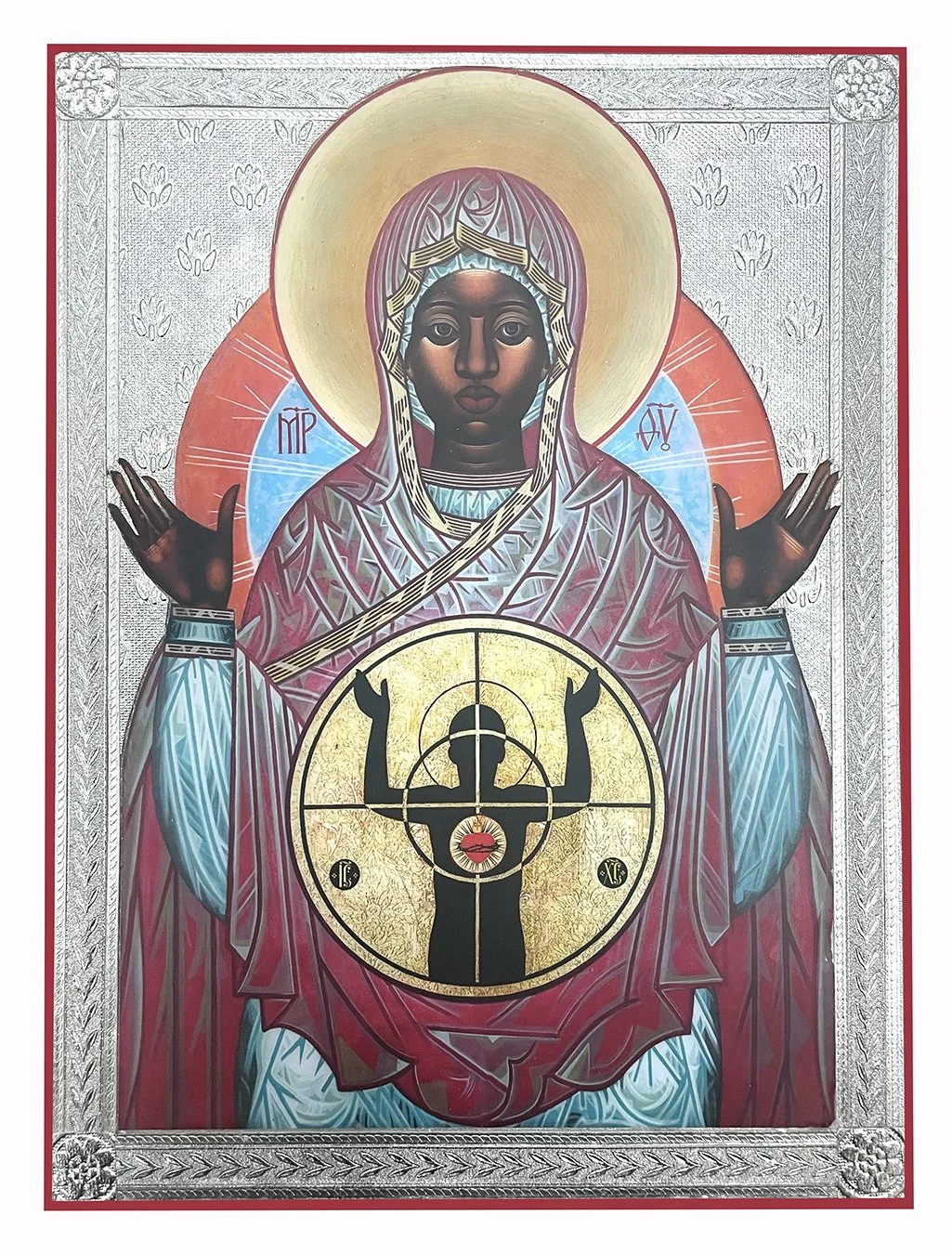
Mark Doox, Our Lady of Ferguson , 2025
Acrylic collage painting with silver metal leaf, paper, and pigmented ink on red-painted cradled wood panel, 12 × 16 in.
Our Lady, Mother of Ferguson and All Those Killed by Gun Violence demonstrates the more solemn possibilities of the method. Here the Byzantine language does not function primarily as parody. Its sacred structure is transferred onto contemporary Black suffering. The transformation is conceptually simple but emotionally complicated: a visual language historically used to represent sacred grief becomes capable of holding another history of grief.
Elsewhere Doox deliberately makes the collision much harder to assimilate.
The exhibition Love Has Never Been a Popular Movement brings together figures such as Typical White Christ, Jesus Impossible: The Black Messiah, and Baphomet Saint Sambo. Christianity is not merely attacked from outside. Its own visual and theological language is turned upon itself.
This is one reason describing Doox simply as a political artist is inadequate. Political content is certainly present, but politics is being conducted through a sustained investigation of representation. The deeper question running through the work is not merely who has power, but how signs acquire the power to tell us what we are seeing.
That question becomes even clearer in Doox's 366-page book The N-Word of God.
The book reveals that BYZ DADA is not confined to painting. Byzantine iconography, collage, Black Signifyin(g), theology, minstrelsy, American history, superheroes, prophetic literature, and satire are extended across hundreds of pages into an elaborate literary-visual cosmology.
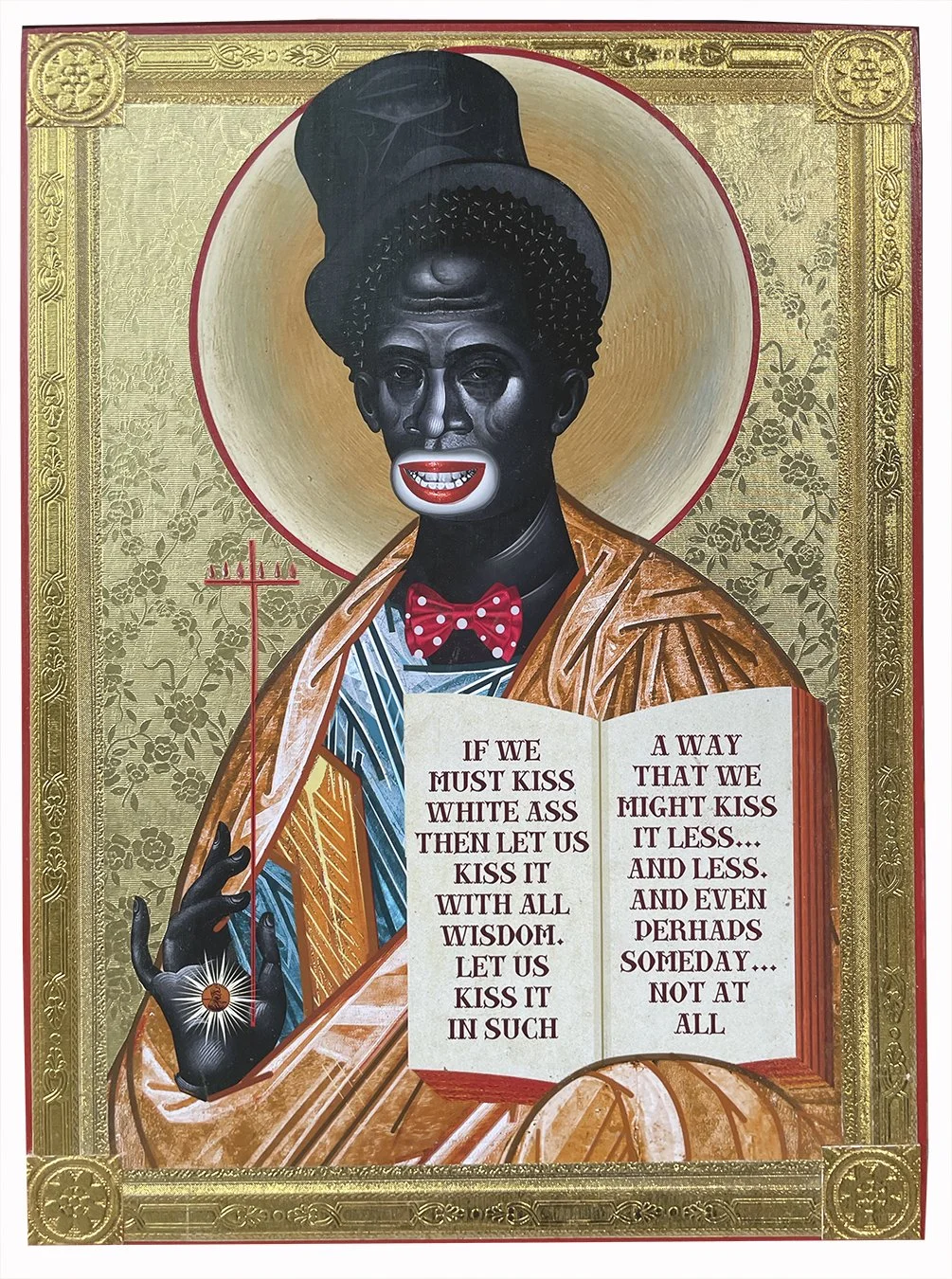
Mark Doox, Saint Sambo, 2025 Acrylic collage painting with gold metal leaf, paper, and
pigmented ink on red-painted cradled wood panel, 12 × 16 in.
At its center stands Saint Sambo, who is later deemed by the Divine White Booty and the Ass Holy of Holies to be a devil and thus becomes Satan Sambo— though Satan Sambo’s previous incarnation of Saint Sambo remains perhaps Doox's most elegant invention, where stereotype and archetype collide.
Satan Sambo pushes the idea of straight forward Black truth tellers about America being demonized to its obvious though challenging visual conclusion even if they lift up purported ideals.
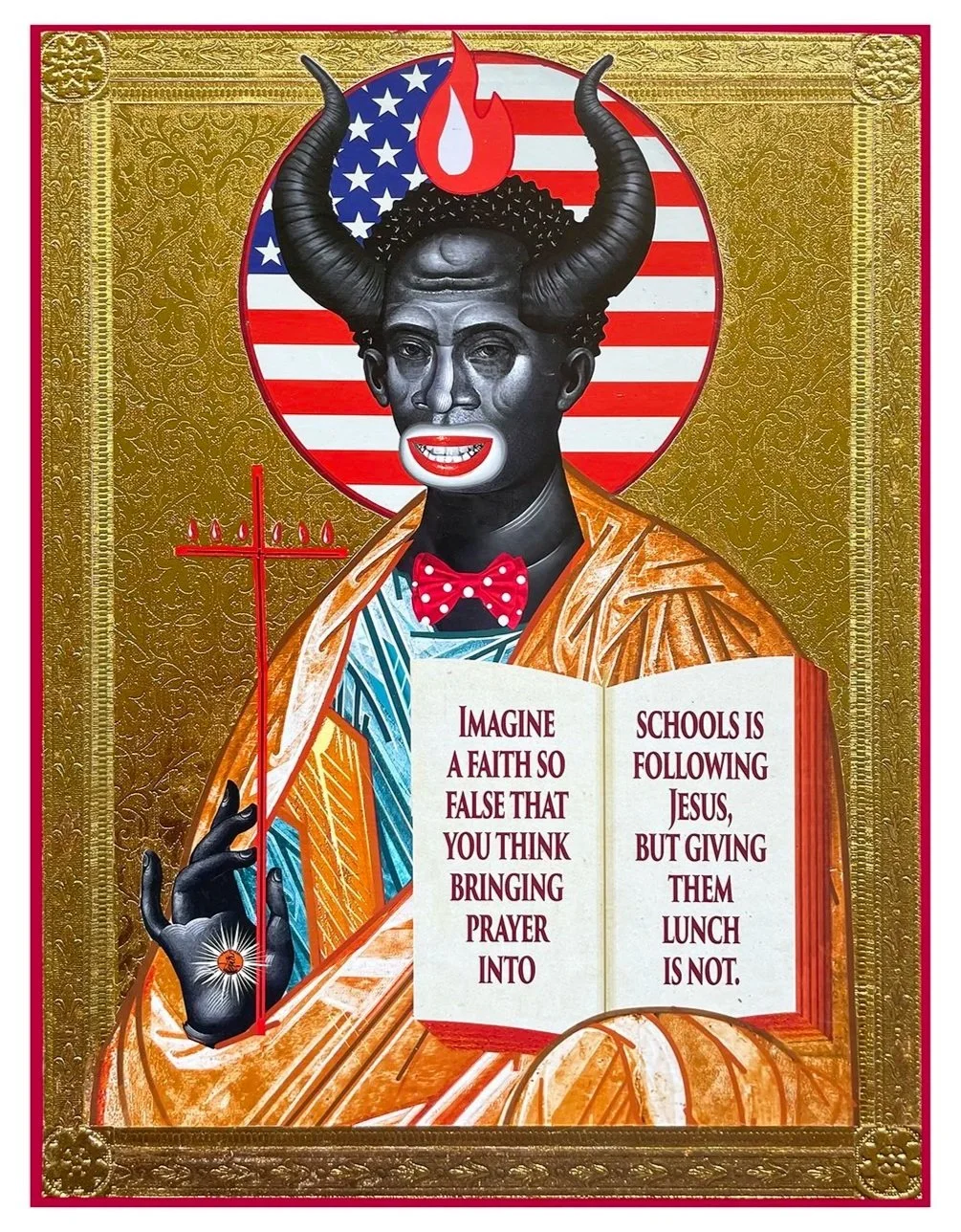
Mark Doox, Baphomet Saint Sambo, 2026 Acrylic collage painting with gold metal leaf, paper, and pigmented ink on red-painted cradled wood panel, 12 × 16 in.
One of Satan Sambo's declarations could function as an interpretive key to Doox's entire practice:
“That which is seen is not me! It is only a delusion of me.” — Satan Sambo
The sentence describes a problem that Doox has spent much of his career constructing for the viewer.
What exactly are we seeing?
A stereotype? An icon? A Black man? A racist representation of a Black man? A saint represented through racist imagery? An attack upon Christianity? A Christian argument conducted through blasphemy?
The work repeatedly frustrates the desire to settle the question.
That is also where its danger lies.
Doox demands considerable visual and cultural literacy from his audience. Remove one of these images from its larger symbolic system and it can become extraordinarily easy to misread. A viewer unfamiliar with minstrelsy, Byzantine iconography, Black vernacular traditions, or Signifyin(g) may initially encounter only provocation.
Yet the work also resists that misrecognition. At its most precise, Doox constructs the relationships between signs so tightly that the provocation begins to explain itself.
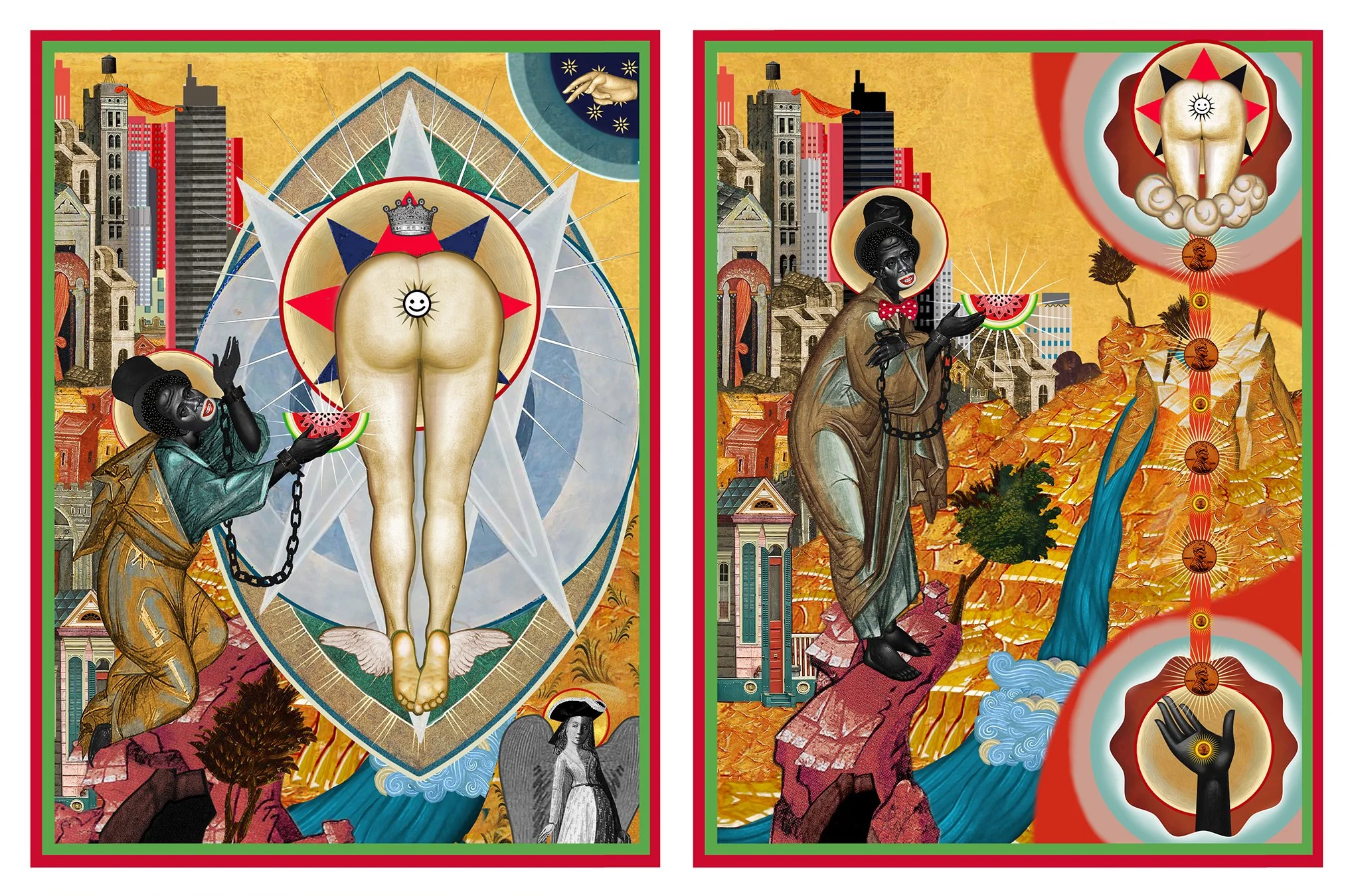
Mark Doox, The Revelation of The Divine White Booty and the Ass Holy of Holies, Page 79 The N-Word of God, Fantagraphics, 2024
Mark Doox, The Revelation The Stigamata of The Coon Christ, Page 87, The N-Word of God, Fantagraphics, 2024
Consider one of the stranger constructions in The N-Word of God. The Divine White Booty contains the Ass Holy of Holies, from which coins fall into the Black palm of Saint Sambo, producing what the book calls the Stigmata of the Coon Christ.
This is outrageous, but it is not arbitrary. “Holy of Holies” invokes the innermost sacred space, the place of divine presence. “Ass Holy of Holies” simultaneously profanes that language and relocates White sacred authority into the Divine White Booty. Money emerges from this sacralized white entity. The coins strike Saint Sambo's Black palm. The wound becomes stigmata. Sambo becomes Coon Christ.
The obscenity has syntax.
More importantly, the obscenity has an object. It is not present merely for obscenity's sake. It points toward a contradiction at the center of the religious and racial system Doox is constructing: the distortion of a God professed to be a God of love into a divine sanction for racial hierarchy, domination, accommodation, and power.
The obscenity therefore does not merely violate the sacred. It asks what has already violated the sacred.
Which is the greater profanity: calling the seat of divine white authority the Ass Holy of Holies, or constructing a racial order of domination and placing the authority of a God of love behind it?
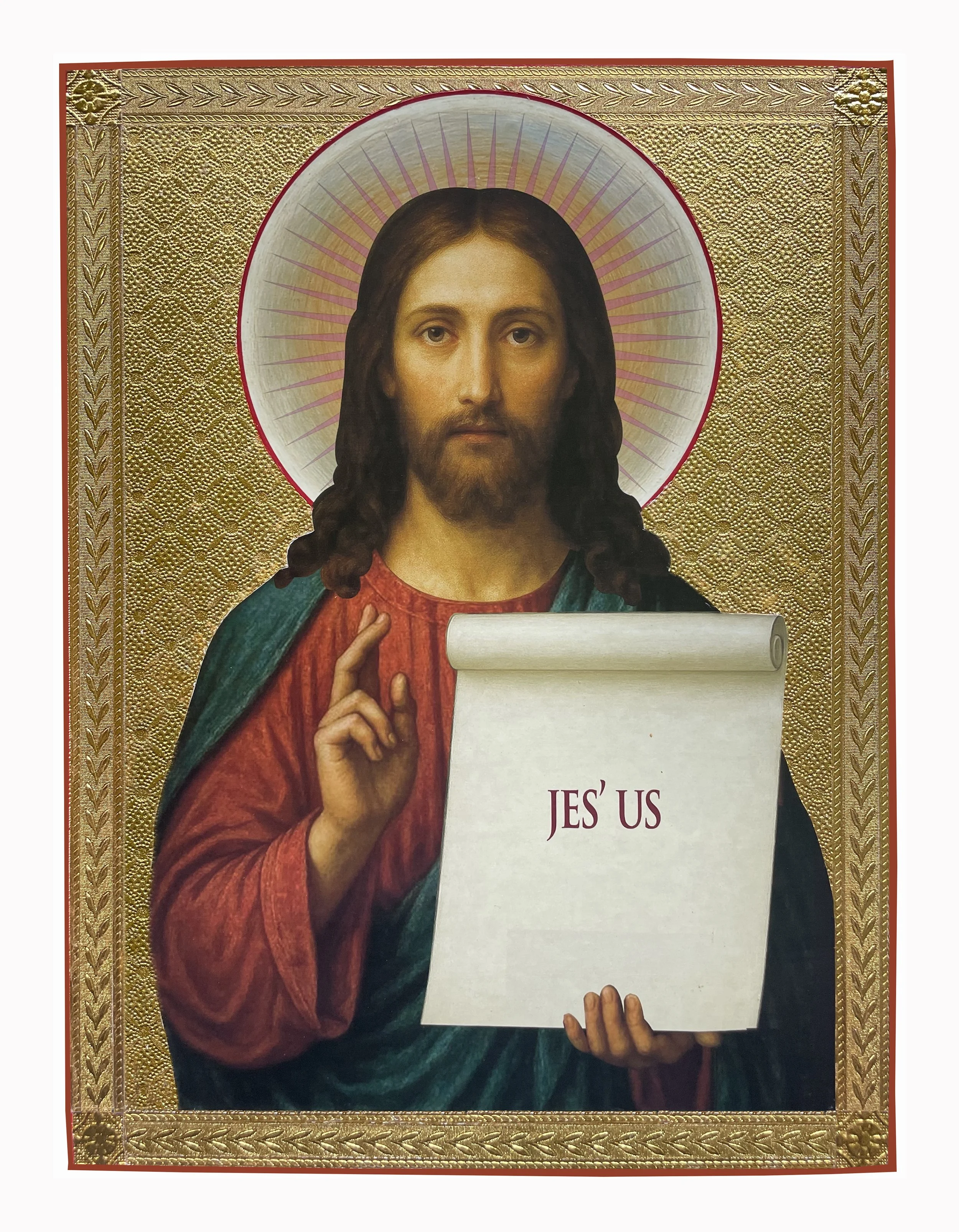
Mark Doox, Jes’ Us Christ, 2026Acrylic collage painting with gold metal leaf, paper, and pigmented ink on red-painted cradled wood panel, 12 × 16 in.
God of love → racial domination → something is profoundly wrong with this picture.
That's the true obscenity. Doox is just pointing it out.
The relationships between these signs are doing real intellectual work. The joke carries an argument. Indeed, the obscene joke is not merely concealing an argument beneath its vulgarity. The obscene joke is the form in which the argument thinks.
This is why even a viewer who does not possess the scholarly vocabulary of Signifyin(g), Byzantine iconography, racial representation, or theological satire may nevertheless recognize what is happening. The viewer may not be able to name every operation, but the construction itself communicates. At a certain level of precision, the work begins to teach the viewer how to read it.
This complicates the problem of misrecognition. Doox's work simultaneously risks misrecognition and resists misrecognition. Its culturally explosive signs can be detached from their contexts and mistaken for the very things they are being made to signify upon. Yet at its most precise, the work constructs these collisions with such specificity that reducing them to mere provocation requires ignoring relationships plainly present in the work.
Misrecognition, then, is not simply a problem surrounding this work.
Misrecognition is one of its subjects.
Doox repeatedly presents viewers with signs they believe they already understand and then destabilizes the relationship between the sign and what it supposedly represents.
That places his practice within several recognizable traditions without comfortably locating it inside any one of them. There is something of Dada's appropriation, the readymade's displacement of meaning, the artist's book, Black satire, prophetic literature, Byzantine iconography, and the elaborate personal mythmaking of William Blake.
Yet these comparisons ultimately describe ingredients rather than the resulting language.
After decades of work, Doox has accomplished something considerably harder than developing a recognizable visual style. He has constructed a symbolic system.
The figures recur. The theology develops. Images migrate between contexts. Characters change identities. Religious symbols acquire racial meanings, and racial symbols acquire theological ones. Ideas begun in paintings continue through books and return to later paintings transformed.
Seen this way, individual works by Doox are not isolated statements. They are fragments of a larger cosmology.
And that may ultimately be the most useful way to understand him: not simply as a Black artist making religious images, nor as an iconographer making political art, but as an artist who has spent decades constructing a peculiar American mythology from the damaged symbolic material he inherited.
The iconographer practices iconoclasm without ceasing to be an iconographer.
That contradiction is not a problem Doox needs to resolve.
That is what the viewer is called to do.
THE ICONOGRAPHER WHO PRACTICES ICONOCLASM
There is something immediately contradictory about the work of Mark Doox. His paintings look as though they are asking to be venerated and vandalized at the same time.
Gold halos, frontal figures, flattened space, hieratic poses, and the visual authority of Byzantine religious painting coexist with racist caricature, Black popular culture, American political mythology, comic-book imagery, obscenity, and satire. Jesus appears beside Sambo. Sacred figures acquire the visual vocabulary of minstrelsy. American racial mythology enters the picture plane carrying both the authority of religion and the absurdity of Dada.
Doox calls the resulting language BYZ DADA—Byzantine Dadaism. The name initially sounds like another artist's convenient description of a hybrid style. Spend enough time with the work, however, and it begins to look more like a description of its underlying machinery.
Doox is an iconographer who practices iconoclasm.
That contradiction is fundamental to the work.
His relationship to Byzantine imagery is not merely stylistic. Doox encountered iconography through religious life and practice, and consequently approaches the icon as a functioning system of signs. Gold means something. The halo means something. Frontal presentation means something. Hierarchy means something. An icon does not simply depict a sacred subject; it places that subject within an established structure of meaning.
Doox retains that structure while introducing other American signs whose meanings are equally difficult to escape.
Among the most volatile of these is racist caricature.
The Sambo figure enters Doox's work already burdened by American history. Rather than eliminating that burden, Doox exploits it. The viewer is required to encounter the stereotype and whatever assumptions accompany it. But the figure does not remain where American visual culture placed him. Sambo becomes saint, prophet, fool, devil, theologian, and eventually something approaching an archetype.
The operation belongs to the tradition Henry Louis Gates Jr. famously theorized as Black Signifyin(g): repetition with a difference, inversion, parody, indirection, and the appropriation of inherited language for purposes its previous owners did not intend.
Doox extends that operation beyond language and onto the picture plane.
An image signifies upon another image.
A Byzantine icon signifies upon a racist caricature. The caricature signifies back upon the icon. Christian imagery signifies upon American racial mythology. Black history signifies upon Christianity. Dada signifies upon devotional art. Comic books signify upon religious painting. None of the original meanings completely disappears.
That last point is crucial.
Doox's pictures work precisely because their source languages remain audible beneath their transformations. If the racist image ceased to be recognizable as racist imagery, much of the tension would disappear. If the Byzantine structure ceased to carry sacred authority, its collision with profanity would lose its force. The paintings require incompatible meanings to occupy the same space.
This helps explain why Doox's work can be so difficult to classify. It can appear devotional and blasphemous, reverent and ridiculous, Black and post-Black, Christian and heretical, comic and deadly serious—sometimes within the same image.
Mark Doox, Watching Miss Rosemary’s Baby, 2025
Acrylic collage painting with gold metal leaf, paper, and pigmented ink on red-painted cradled wood panel, 12 × 16 in.
Mark Doox, Watching Miss Rosemary’s Baby, 2025
Acrylic collage painting with gold metal leaf, paper, and pigmented ink on red-painted cradled wood panel, 12 × 16 in.
Our Lady, Mother of Ferguson and All Those Killed by Gun Violence demonstrates the more solemn possibilities of the method. Here the Byzantine language does not function primarily as parody. Its sacred structure is transferred onto contemporary Black suffering. The transformation is conceptually simple but emotionally complicated: a visual language historically used to represent sacred grief becomes capable of holding another history of grief.
Elsewhere Doox deliberately makes the collision much harder to assimilate.
The exhibition Love Has Never Been a Popular Movement brings together figures such as Typical White Christ, Jesus Impossible: The Black Messiah, and Baphomet Saint Sambo. Christianity is not merely attacked from outside. Its own visual and theological language is turned upon itself.
This is one reason describing Doox simply as a political artist is inadequate. Political content is certainly present, but politics is being conducted through a sustained investigation of representation. The deeper question running through the work is not merely who has power, but how signs acquire the power to tell us what we are seeing.
That question becomes even clearer in Doox's 366-page book The N-Word of God.
The book reveals that BYZ DADA is not confined to painting. Byzantine iconography, collage, Black Signifyin(g), theology, minstrelsy, American history, superheroes, prophetic literature, and satire are extended across hundreds of pages into an elaborate literary-visual cosmology.
Mark Doox, Watching Miss Rosemary’s Baby, 2025Acrylic collage painting with gold metal leaf, paper, and
pigmented ink on red-painted cradled wood panel, 12 × 16 in.
At its center stands Saint Sambo, who is later deemed by the Divine White Booty and the Ass Holy of Holies to be a devil and thus becomes Satan Sambo— though Satan Sambo’s previous incarnation of Saint Sambo remains perhaps Doox's most elegant invention, where stereotype and archetype collide.
Satan Sambo pushes the idea of straight forward Black truth tellers about America being demonized to its obvious though challenging visual conclusion even if they lift up purported ideals.
Mark Doox, Baphomet Saint Sambo, 2026 Acrylic collage painting with gold metal leaf, paper, and pigmented ink on red-painted cradled wood panel, 12 × 16 in.
One of Satan Sambo's declarations could function as an interpretive key to Doox's entire practice:
“That which is seen is not me! It is only a delusion of me.” — Satan Sambo
The sentence describes a problem that Doox has spent much of his career constructing for the viewer.
What exactly are we seeing?
A stereotype? An icon? A Black man? A racist representation of a Black man? A saint represented through racist imagery? An attack upon Christianity? A Christian argument conducted through blasphemy?
The work repeatedly frustrates the desire to settle the question.
That is also where its danger lies.
Doox demands considerable visual and cultural literacy from his audience. Remove one of these images from its larger symbolic system and it can become extraordinarily easy to misread. A viewer unfamiliar with minstrelsy, Byzantine iconography, Black vernacular traditions, or Signifyin(g) may initially encounter only provocation.
Yet the work also resists that misrecognition. At its most precise, Doox constructs the relationships between signs so tightly that the provocation begins to explain itself.
Mark Doox, The Revelation of The Divine White Booty and the Ass Holy of Holies, Page 79 The N-Word of God, Fantagraphics, 2024
Mark Doox, The Revelation The Stigamata of The Coon Christ, Page 87, The N-Word of God, Fantagraphics, 2024
Consider one of the stranger constructions in The N-Word of God. The Divine White Booty contains the Ass Holy of Holies, from which coins fall into the Black palm of Saint Sambo, producing what the book calls the Stigmata of the Coon Christ.
This is outrageous, but it is not arbitrary. “Holy of Holies” invokes the innermost sacred space, the place of divine presence. “Ass Holy of Holies” simultaneously profanes that language and relocates White sacred authority into the Divine White Booty. Money emerges from this sacralized white entity. The coins strike Saint Sambo's Black palm. The wound becomes stigmata. Sambo becomes Coon Christ.
The obscenity has syntax.
More importantly, the obscenity has an object. It is not present merely for obscenity's sake. It points toward a contradiction at the center of the religious and racial system Doox is constructing: the distortion of a God professed to be a God of love into a divine sanction for racial hierarchy, domination, accommodation, and power.
The obscenity therefore does not merely violate the sacred. It asks what has already violated the sacred.
Which is the greater profanity: calling the seat of divine white authority the Ass Holy of Holies, or constructing a racial order of domination and placing the authority of a God of love behind it?
Mark Doox, Jes’ Us Christ, 2026Acrylic collage painting with gold metal leaf, paper, and pigmented ink on red-painted cradled wood panel, 12 × 16 in.
God of love → racial domination → something is profoundly wrong with this picture.
That's the true obscenity. Doox is just pointing it out.
The relationships between these signs are doing real intellectual work. The joke carries an argument. Indeed, the obscene joke is not merely concealing an argument beneath its vulgarity. The obscene joke is the form in which the argument thinks.
This is why even a viewer who does not possess the scholarly vocabulary of Signifyin(g), Byzantine iconography, racial representation, or theological satire may nevertheless recognize what is happening. The viewer may not be able to name every operation, but the construction itself communicates. At a certain level of precision, the work begins to teach the viewer how to read it.
This complicates the problem of misrecognition. Doox's work simultaneously risks misrecognition and resists misrecognition. Its culturally explosive signs can be detached from their contexts and mistaken for the very things they are being made to signify upon. Yet at its most precise, the work constructs these collisions with such specificity that reducing them to mere provocation requires ignoring relationships plainly present in the work.
Misrecognition, then, is not simply a problem surrounding this work.
Misrecognition is one of its subjects.
Doox repeatedly presents viewers with signs they believe they already understand and then destabilizes the relationship between the sign and what it supposedly represents.
That places his practice within several recognizable traditions without comfortably locating it inside any one of them. There is something of Dada's appropriation, the readymade's displacement of meaning, the artist's book, Black satire, prophetic literature, Byzantine iconography, and the elaborate personal mythmaking of William Blake.
Yet these comparisons ultimately describe ingredients rather than the resulting language.
After decades of work, Doox has accomplished something considerably harder than developing a recognizable visual style. He has constructed a symbolic system.
The figures recur. The theology develops. Images migrate between contexts. Characters change identities. Religious symbols acquire racial meanings, and racial symbols acquire theological ones. Ideas begun in paintings continue through books and return to later paintings transformed.
Seen this way, individual works by Doox are not isolated statements. They are fragments of a larger cosmology.
And that may ultimately be the most useful way to understand him: not simply as a Black artist making religious images, nor as an iconographer making political art, but as an artist who has spent decades constructing a peculiar American mythology from the damaged symbolic material he inherited.
The iconographer practices iconoclasm without ceasing to be an iconographer.
That contradiction is not a problem Doox needs to resolve.
That is what the viewer is called to do.
Mark Doox, Watching Miss Rosemary’s Baby, 2025Acrylic collage painting with gold metal leaf, paper, and
pigmented ink on red-painted cradled wood panel, 12 × 16 in.