
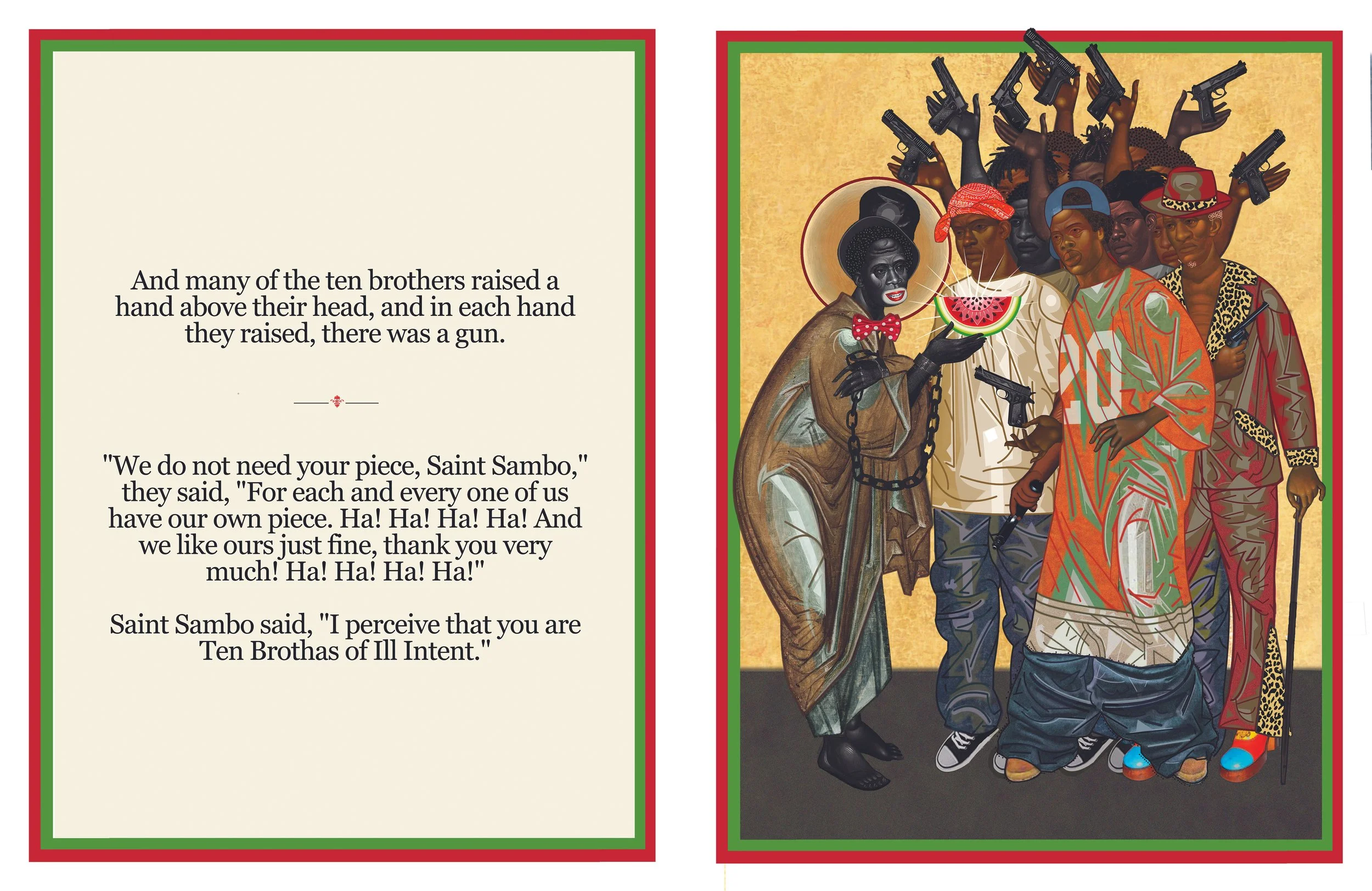
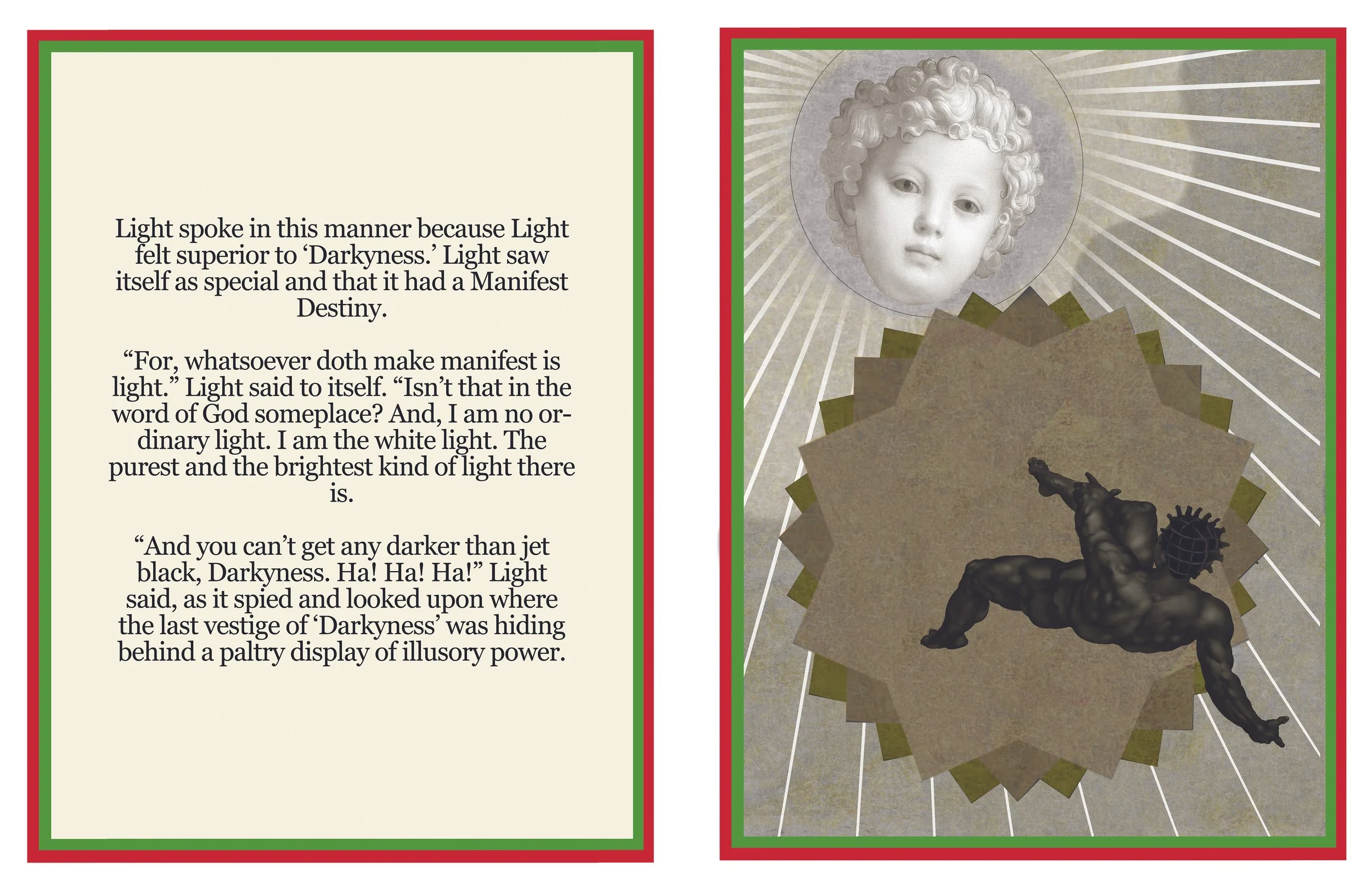
The N–Word of God
Buy it because you are unlikely to own another book quite like it. Read it because it is doing something worth figuring out. And if you are interested in Black literature, visual culture, comics, theology, satire, conceptual art, or the strange borderland where all of those things meet, this is a book worth being in conversation with.
A seriously great and deeply strange American book.
The N-Word of God at various moments resembles a graphic novel, an illuminated manuscript, a theological satire, an artist’s book, a Black philosophical tract, a mock scripture, a collage novel, and an extended act of cultural blasphemy. It is all of those things, but none adequately contains it.
“If we must kiss White ass let us kiss it in all wisdom. Let us kiss it in such a way that in the future we might not kiss it at all.” — Saint Sambo
What gradually emerges is an entire literary and visual world constructed according to the logic of Black Signifyin(g). Words signify upon words. Images signify upon images. Christian iconography collides with racist caricature; American patriotic mythology with Black history; superheroes with lynching photographs; sacred language with obscenity; Saint Sambo with Satan Sambo; Black with White. Eventually the book begins to signify upon its own propositions.
“Many Hues One Humanity” — Satan Sambo
Its excess is therefore part of its method. The repetitions, contradictions, jokes, theological inventions, stereotypes, comic-book forms, and visual collisions are not simply provocations. They form a system in which meanings are established, repeated with difference, inverted, contaminated, desacralized, and reconstructed.
At the center of the book is Saint Sambo/Satan Sambo: racist caricature, holy fool, trickster, prophet, devil, American stereotype, archetype, and theological contradiction at once. Through him, the book asks whether the reader can move through the accumulated signs of race, religion, history, and representation and perceive something more difficult underneath them.
A MODERN DAY WAY COOL-ASS WILLIAM BLAKE
Like Blake, Doox refuses to separate visionary insight and human imagination, theology from sublime art, or a personal symbolic universe from an argument about the nature of reality.
One of the book’s central declarations becomes a key to the whole work:
“That which is seen is not me! It is only a delusion of me.” — Satan Sambo
That sentence describes not only the character, but the experience of reading the book itself.
Doox draws on Black Signifyin(g), Byzantine iconography, Dada and collage, prophetic literature, Black satire, Gnosticism, superheroes, minstrelsy, American racial mythology, and the spiritual universe of John Coltrane. These elements should not fit together. Somehow they do.
“Say ‘Pink’ until White people say ‘Uncle!’” — Satan Sambo
The N-Word of God is not merely a provocative book about race. It is a highly constructed literary-visual system about how signs shape perception, how inherited images govern consciousness, and how language can both imprison and unsettle the mind.
It deserves to be read seriously.
__________“The N-Word of God feels almost otherworldly, drawing the reader up above this racialized reality of dueling relationships and false binaries.” — Starlette Thomas, Good Faith Media
“Lands like a provocative punch in the chops.” — The New York Times
“It's a mind-blowing work that'll leave readers reeling.” — Mark Judge, Splice Today
